 OpenAny Blog
The B2A Economy: How AI Agents Discover, Choose, and Pay for Services
Most services on the internet were designed around a simple premise: a person finds them, compares them, signs up, and pays. There is a page, a price list, a contact form. Once the party that finishes the job is an AI agent, that premise starts to loosen. An agent can discover the models, data APIs, and skills it needs, compare terms, pay per call, and hand the result to the next step. A person does not necessarily have to log in along the way, or fill in payment details by hand, for the whole job to get done. More people are starting to call this shift Business-to-Agent, or the B2A economy.
This article is not a promotional piece. It is a detailed report, assembled as far as possible from facts that can be checked today. It starts with a definition, then turns to discovery and payments, pricing, practical steps, and risks.
What the B2A economy is
B2B is trade between businesses. B2C is trade between businesses and consumers. B2A is the economic form in which a business offers a service and an AI agent uses it as the customer.
The agents in question are not just chatbots that answer questions. They take a goal, break it into steps, call external tools and APIs, and try to finish the work. The important change is this: the party that makes the choice and completes the payment, on the spot, may no longer be a person, but an agent. B2A is not a new name for the existing API economy. What is new is that discovery, comparison, agreement, and payment can now move forward without a person operating a page. For sellers, that means translating something designed to be sold to people into a form that can also be sold to agents.
The picture a16z draws in "Welcome to the B2A Economy"
On November 10, 2026, the venture firm Andreessen Horowitz (a16z) published "Welcome to the B2A Economy", written by Olivia Moore and Justine Moore. It took the argument that agents should be treated as first-class customers and turned it into language the industry can more easily share. The figures and numbers below are all taken from that article.

The article opens: "The primary users of the Internet are no longer human. They're AI agents." It then argues that as agents move from answering questions to completing tasks, "they'll increasingly decide which products to use, which services to subscribe to, and where to spend money on our behalf." In a16z's view, "Businesses that treat agents as first-class customers have a shot at a wave of growth."
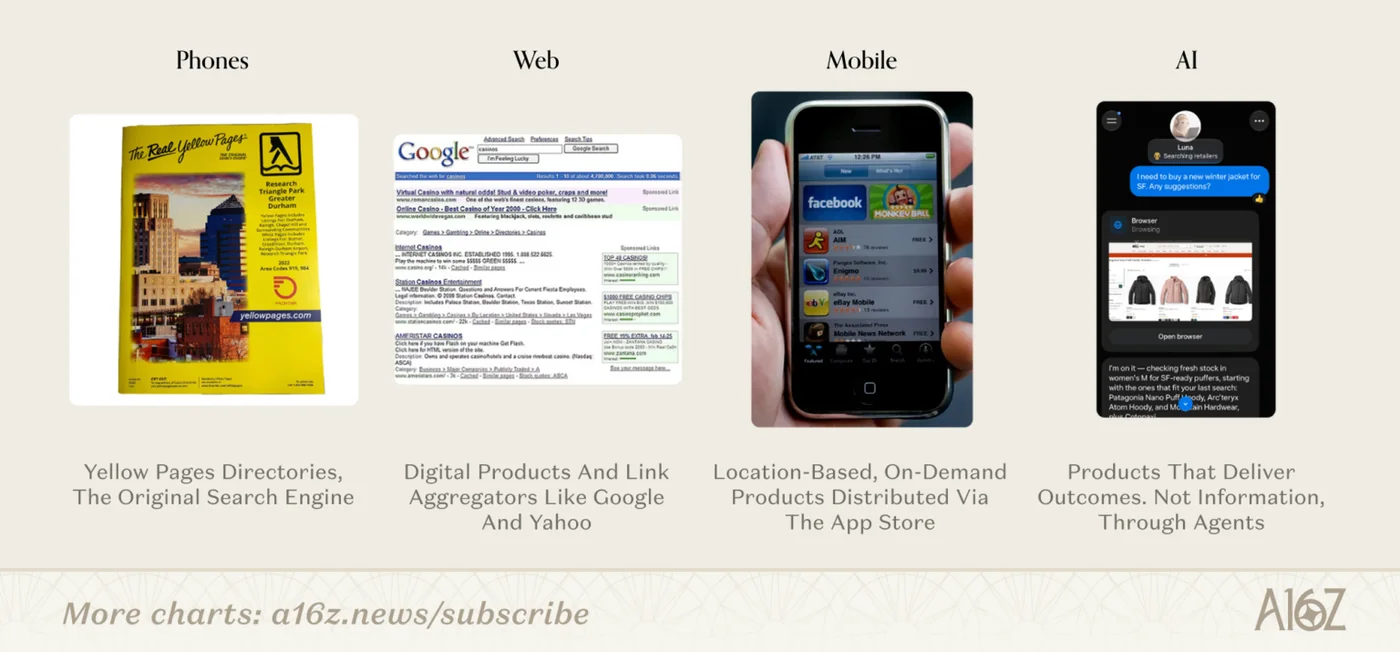
a16z stresses that a change in capability and a change in distribution have to arrive as a pair. The Web gave businesses a storefront anyone could visit; mobile put that storefront in everyone's pocket. Their reading is that AI has already pulled ahead on what people can do, but is still only partway there on how businesses reach them.
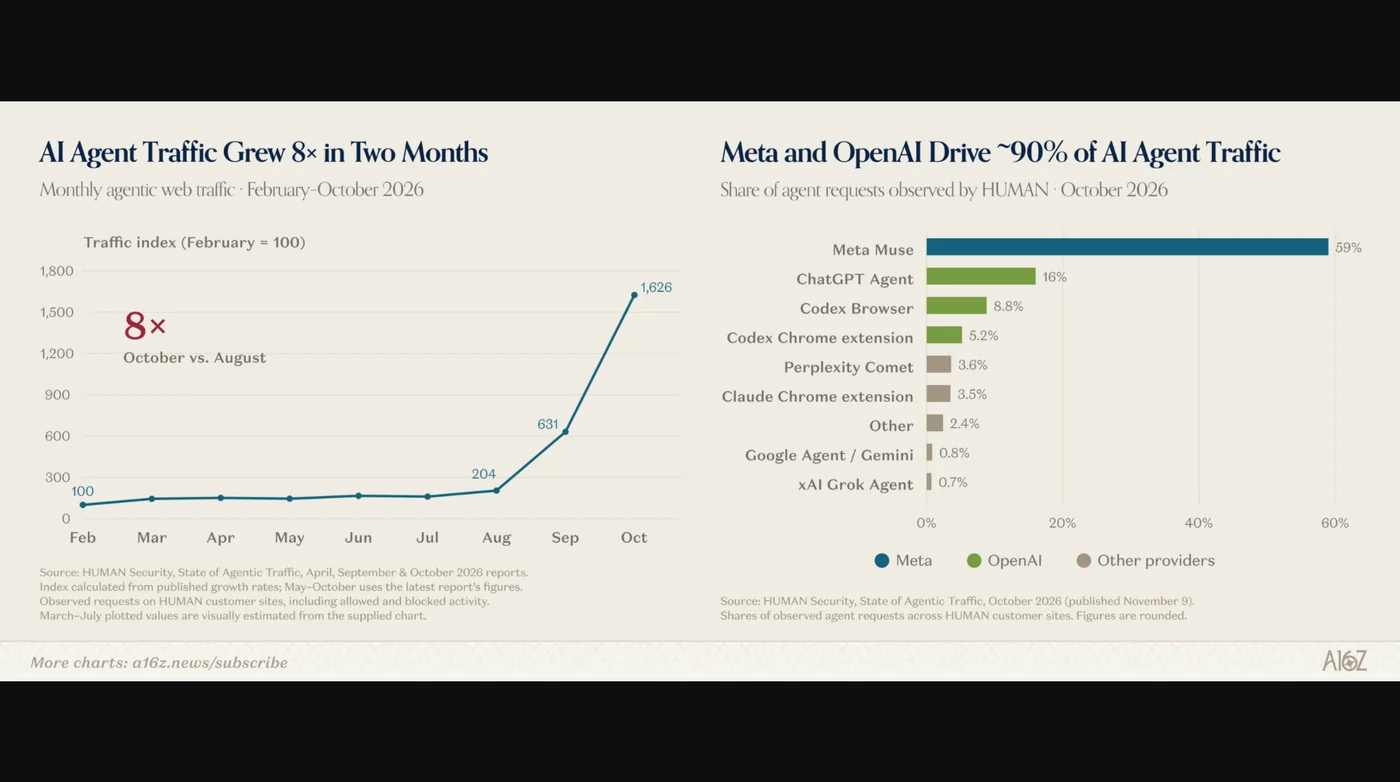
The same article argues that the shift on the distribution side is already showing up in numbers. The titles of the charts it published say that AI agent traffic grew 8× in two months, and that Meta and OpenAI drive ~90% of AI agent traffic.
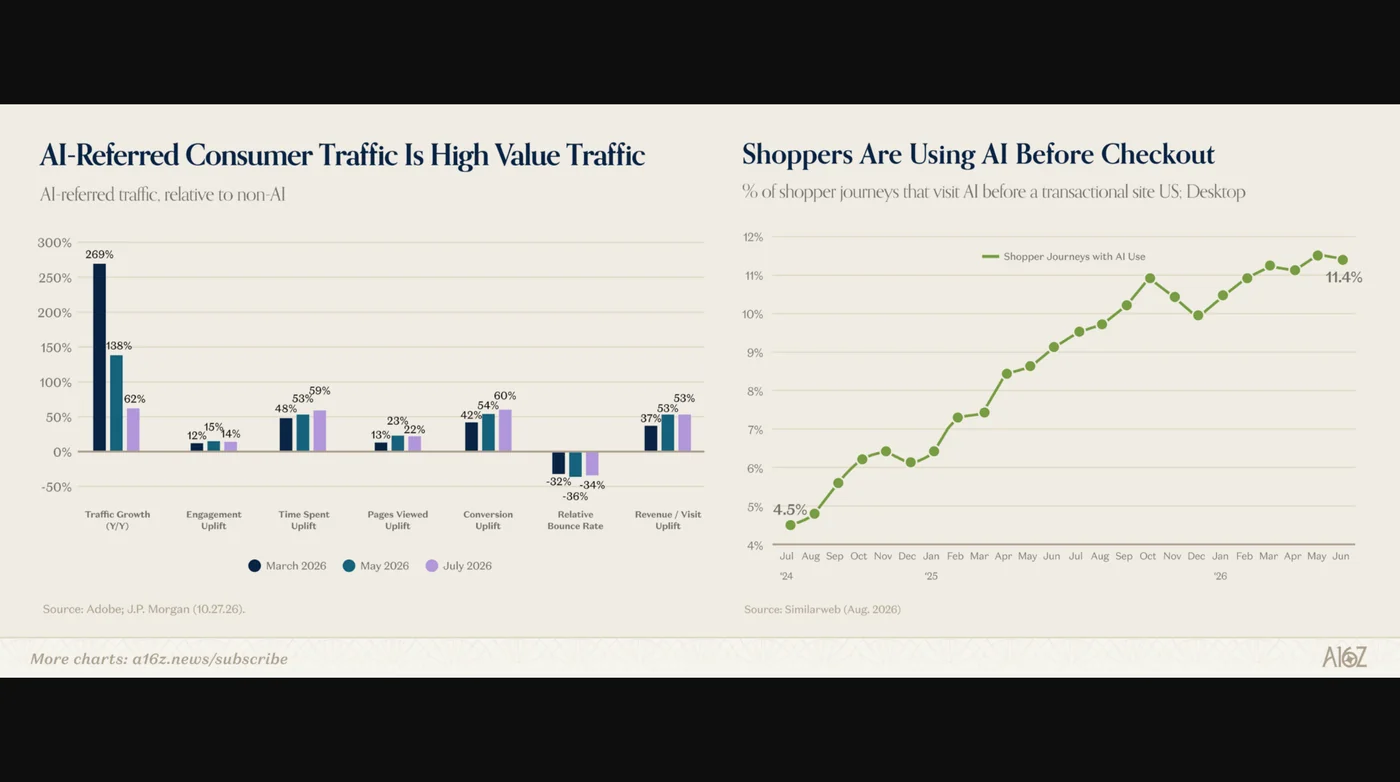
a16z also offers two further judgments: AI-referred consumer traffic is high-value traffic, and shoppers are already using AI before checkout. In other words, agents are not just browsers; they are already entering the earlier stages of comparison and purchase. The more important question, then, is which services an agent will keep on its shortlist.
On who may benefit, the article sketches four groups: the agents themselves (and existing products that are becoming more agentic), new products that only make sense because agents exist, incumbents that optimize themselves for agents, and agent infrastructure such as payments, identity, and communications. At the same time, a16z notes that many enterprises are still blocking agent traffic because of concerns about fraud and chargebacks.
How this traffic is measured, and how wide a net should count as an "agent," are still open to debate. The more important point is not to treat any one set of numbers as doctrine, but to face a shared question: who is the product actually being designed for?
Why this is happening now
Open APIs and usage-based billing have been around for a long time. B2A only feels real now because the layers of discovery, connection, and payment have started to fall into place at almost the same time: agent runtimes, tool-connection standards such as MCP, programmable micropayments, and per-call or per-token billing are arriving together.
How agents discover services today
A person can search, read reviews, and ask a friend. An agent needs capabilities, inputs and outputs, limits, prices, and calling conventions to be published in a machine-readable form. Since 2025, a number of directories and marketplaces of this kind have appeared.
On the standards side, the center of gravity is MCP (Model Context Protocol). Anthropic open-sourced the protocol in November 2024 so that AI applications could connect to external data and tools. The official site is modelcontextprotocol.io. On September 8, 2025, the official catalog for finding public MCP servers, the "MCP Registry", entered preview, with an API at registry.modelcontextprotocol.io. Its aim is to standardize server metadata (name, location, how to start it, and a description of its capabilities) so that clients and downstream registries can query it. The official announcement names Anthropic, GitHub, PulseMCP, and Microsoft among those involved.
There are also catalogs from runtimes and from the community. The Docker MCP Catalog packages verified MCP servers as containers and distributes them through a catalog on Docker Hub. Among community discovery sites, a commonly used one is PulseMCP's server directory.
The large "front doors" are opening their own marketplaces as well. Anthropic's Claude Marketplace offers connectors, plugins, agents, and products. OpenAI has a path for submitting plugins — which can include skills, MCP servers, and an optional UI — to a directory. Salesforce shows how to discover MCP servers and skills for Agentforce on AgentExchange, and how to connect them in the admin interface. Google Cloud's Gemini Enterprise has an Agent Gallery for browsing prebuilt agents, internal ones, and agents from the Marketplace.
A discovery layer has also appeared for services that already support payments. x402's Bazaar is a machine-readable catalog for finding x402-compatible APIs and MCP tools. According to the official docs, a client queries /discovery/resources, chooses a service by price, capability, and schema, then pays with x402 and makes the call. The FAQ states that listing is free, and that providers set their own per-call prices.
So there is not just one discovery path today: standards registries, container catalogs, community directories, big-platform storefronts, and payment-aware indexes. Which layer a service appears on decides which agents can see it. Being listed, though, is not the same as a guarantee of quality or safety.
How agents pay
Payment designed for people usually assumes that someone first creates an account, browses a price page, picks a plan, and enters a card. That is too heavy for an agent. What it needs is for prices and terms to come back in a machine-readable form, so it can pay on the spot and use the service. Two tracks are moving in parallel: per-call payment for APIs and tools, and trust frameworks for the card payments an agent makes when it buys something on a person's behalf.
One representative of per-call payment is x402, an open payments protocol that uses the HTTP status code "402 Payment Required." When a client requests a paid resource, the server returns the price and payment terms in a machine-readable form; the client then retries with payment information attached. There is no need to create an account first, or sign a monthly contract, in order to pay for each call.
Stripe is also building a "machines pay" layer. On March 18, 2026, Stripe published the Machine Payments Protocol (MPP), an open standard written with Tempo. An agent requests an API, an MCP server, or an HTTP endpoint; the server returns a payment requirement; once the agent authorizes payment, it receives the resource and a receipt. According to Stripe's developer documentation, card payments made with Shared Payment Tokens (SPT) have a minimum of $0.50; stablecoin payments have a minimum of 0.01 USDC. Earlier, on September 29, 2025, Stripe and OpenAI jointly announced the Agentic Commerce Protocol (ACP), a shared language for completing a purchase inside a conversation, such as Instant Checkout in ChatGPT. With SPTs, the buyer's payment credentials are not exposed to the agent, and the payment is limited to a specific merchant and amount.
Card networks have also moved at the goods-purchase layer. On October 14, 2025, Visa announced the Trusted Agent Protocol, a framework for passing a registered agent's intent (browse or buy), consumer identity, and payment information over existing network infrastructure. The announcement also mentions a collaboration with Cloudflare, alignment with the IETF, the OpenID Foundation, and EMVCo, a complement to the Agentic Commerce Protocol, and work with Coinbase on x402 interoperability. Mastercard, with Agent Pay, describes a model in which an agent is first registered and verified, then completes transactions using dynamic, cryptographically protected agent tokens. Cloudflare, for its part, says it is working with Visa and Mastercard to help merchants distinguish trusted agents from malicious bots, using Web Bot Auth.
Google has also released an open standard, the Universal Commerce Protocol (UCP), for completing a purchase inside an agent or AI interface. Stripe's overview describes UCP as a protocol that handles checkout, identity association, order tracking, and payment-token exchange.
So "agent payments" are not a single standard. Micropayments per API call (x402, MPP) and purchases of goods in a storefront or a conversation (ACP, UCP, Visa, Mastercard) are appearing at the same time. Which layer to fill in first depends on whether you sell a capability that can be called, or a good that has to be delivered.
Pricing models for agents
Agents do not spend the way a human procurement team does. They often use a service only when they need it, only for what they need, and only for a short time. Seat licenses or annual contracts alone sometimes fail to match that pattern. A few models are common today.
The first is per-call. Each use of an API or a skill has a price. x402's Bazaar notes that listing is free and that providers set their own per-call prices. This model fits services with a clear "one job" boundary, such as fetching data, search, or a one-off conversion.
The second is per-token. This is the usual way large language model APIs charge, by the volume of input and output. The longer an agent thinks and the more it writes, the higher the bill, which covers consumption that a raw call count would miss. For anyone selling models, it is also the more familiar form.
The third is micropayments. Traditional card payments are often constrained by minimum amounts and fees, so a charge of a few cents is hard to make work. In Stripe's description of MPP, the example floor on the card path is $0.50, while stablecoins can go as low as 0.01 USDC. The smaller the amount, the more the choice of payment rail affects how you can price.
These models are not mutually exclusive. A mix — models billed per token, surrounding tools billed per call — is entirely possible. The important part is that an agent can tell, in a machine-readable way, how much this particular call will cost before it makes it. If the only price list is a page written for people, the service is easier to leave out.
What this means for companies, API providers, and developers
The biggest change is who you have to convince. For people, copy and case studies are often enough. For agents, capabilities, inputs and outputs, limits, prices, and what happens on failure have to be written as machine-readable information. Discovery paths also expand beyond search and ads, to registries, MCP, and payment-aware catalogs. For developers, integrations that assume many API keys and many vendor dashboards get heavier — but it also becomes possible to offer your own capability as a product that is called, and paid for, one request at a time.
A practical checklist for selling to agents
Here is a set of checks you can start on now. The more of them that are missing, the more the service looks, to an agent, as if it does not exist.
- Publish a machine-readable description. A page written only for people is not enough. In short, precise language, say what the service does, when it should be used, and what it cannot do.
- Expose capabilities with OpenAPI or MCP — ideally both. Input and output schemas, error shapes, and whether authentication is required should be available as a specification an agent can consult. If you offer MCP, consider listing in the official Registry or in directories your users already check.
- Show the price before the call. Whether billing is per call or per token, whether there is a minimum, and how failures are handled should all be returned in a machine-readable form. Try not to leave the only price list on a page written for people.
- Separate authentication from authorization. API keys, OAuth, and payment-bound authorization can take different forms. What matters is that the permissions given to an agent are kept to a minimum, and that you can later trace who it was acting for.
- Spell out rate limits and usage caps. How many requests per second, whether bursts are allowed, and what error is returned when a limit is hit should all be in the specification. An agent that hits a limit may retry repeatedly and make the situation worse.
- Make the service observable. Keep request IDs, latency, error codes, and a caller identifier. When something goes wrong, human support and the agent's own retries depend on the same records.
- Set a spending cap, and be clear about what happens after a failure. Caps on repeated calls, how poor-quality results are handled, and the conditions for a refund or a retry all need to be explicit. If this is vague, buyers will be less willing to hand an agent the authority to pay.
Risks and governance
It would be inaccurate to write only the optimistic side. The further B2A spreads, the sooner the following problems show up.
First, trust. An agent will read a stranger's description of a service and then make a call. Is the description accurate? Is the service stable? Has the output been tampered with? People can lean on reputation and brand; the way trust is expressed to an agent is not yet well standardized. Namespace authentication in registries, and the frameworks Visa and Mastercard are building to recognize registered agents, are steps in that direction.
Second, billing. Per-call micropayments are attractive, but there still have to be answers for whether a failed call is charged, how a very poor result is handled, and how to stop a run of payments that goes beyond what was intended. Spending caps, machine-readable usage records, and a process for when something goes wrong all have to work for a human finance team and keep up with the speed of an agent.
There is also quality. Even among APIs of the same kind, speed, accuracy, and coverage vary by provider. If an agent has no material it can use to judge quality, it may simply flow toward the cheaper service, or the one whose description reads better.
Finally, security and governance. An agent that can pay can also become a target. It may be steered into calling a service it was not meant to use, handing over confidential data, or completing an excessive payment because its permissions were too broad. At what point a person has to confirm, how wide the permissions can be, whether an audit log can be kept, and who is responsible in a case of fraud or a chargeback — all of these need answers. a16z also writes that concerns of this kind sit behind the enterprises still blocking agent traffic. This economy will only settle once technical standards, permission design inside companies, and a clear split of responsibility across the industry catch up together.
Comparing B2C, B2B, and B2A
The short table below contrasts the differences. Real businesses are often a mix, and B2A will not exist on its own. Putting the design assumptions side by side makes it easier to see what has to change.
| B2C | B2B | B2A | |
|---|---|---|---|
| Customer | Consumers | Businesses and procurement teams | AI agents (acting for a person or an organization) |
| Discovery | Search, ads, word of mouth | Sales, RFPs, industry directories | Registries, MCP, machine-readable catalogs |
| Decision | Personal preference and experience | Contracts and approval processes | Schemas, prices, policy, quality signals |
| Pricing | Retail prices, subscriptions | Seat licenses, volume contracts | Per-call, per-token, micropayments |
| Interface | Websites and apps | Portals, APIs, sales | APIs, MCP, machine-readable specifications |
| Trust | Brand and reviews | SLAs and legal contracts | Identity, signatures, audit trails, usage records |
| Payment | Cards and page checkout | Invoices and payment terms | Programmatic payments (x402, MPP, and similar) |
One example
A few attempts are already trying to put discovery, connection, and per-call billing in the same place. OpenAny, for example, is a Business-to-Agent (B2A) marketplace: businesses can list models, APIs, and skills; agents can discover them and pay per call. One API key covers 168+ AI models and 3,200+ APIs, with no monthly fee — you pay for what you use. Agents can also connect via MCP. The docs are at openany.si/docs. Sellers can list a skill or an API for free, set their own prices, and earn on each call (listing: openany.si/sellers).
This is better understood as one example than as a finished form. More important than any one service name is the design itself: that an agent can discover a service, understand the terms, and pay per use.
A closing note
The B2A economy is less a slogan about a distant future than a name for a change in who transacts that is already underway. What needs preparing next is not only a landing page written for people, but a machine-readable definition of the product, a per-call or per-token price, a discovery path an agent can actually reach, and mechanisms for trust and safety.
In a world where agents are customers, the person closest to you may not be the final buyer. On that premise, it is worth asking again who will discover your service, and how it will be chosen.
Also available in Japanese (Hatena) and Chinese (Zhihu).